
HR Software vs Excel in Bangladesh: Which Is Better for Business in 2026?
HR Software vs Excel in Bangladesh
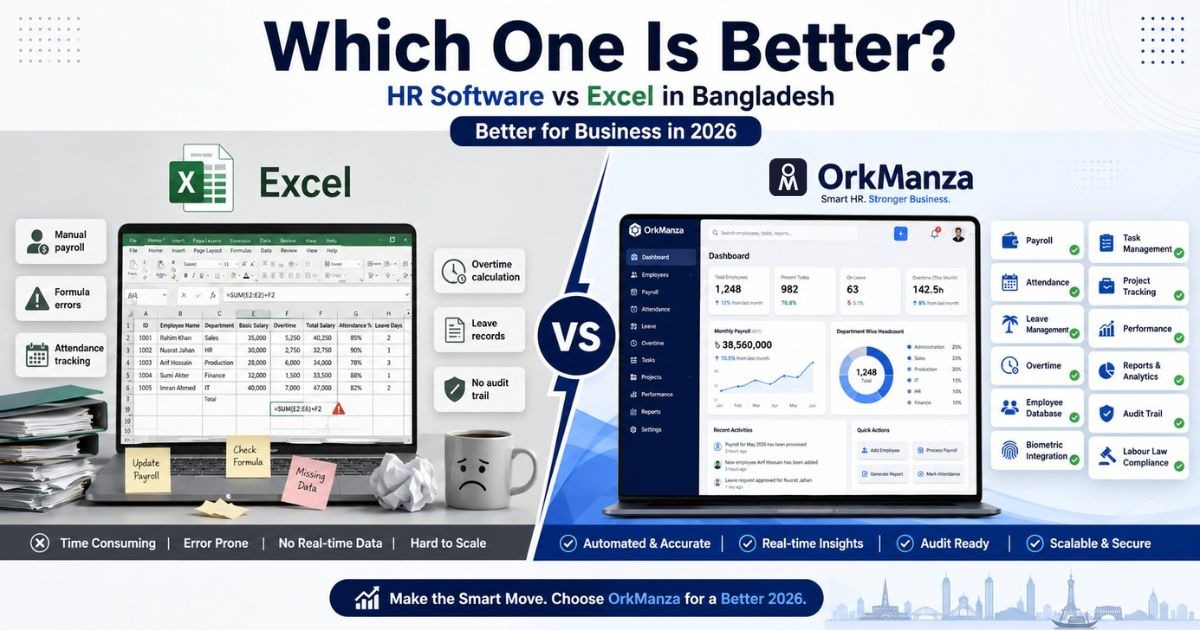
HR Software vs Excel in Bangladesh
Key Takeaways
- What Is HR Software?
- Businesses in Bangladesh Still Use Excel for HR
- Common Problems of Excel-Based HR Management
- Manual vs Automated HR Software
- HR Software vs Excel
- Fingerprint + Software vs Excel
- Productivity Impact
- Businesses in Bangladesh Should Switch
Introduction
For many businesses in Bangladesh, Excel has been the default tool for managing attendance, payroll, employee records, and leave tracking for years.
It feels simple. It feels cheap. Most importantly, it feels familiar.
But here’s the problem.
As businesses grow, managing Excel becomes harder.
HR teams spend hours calculating overtime. Payroll mistakes become common. Leave records go missing. Attendance mismatches create employee frustration. Compliance with the Bangladesh labor law becomes difficult.
This is why the debate over HR software vs. Excel in Bangladesh has become more important than ever.
In 2026, businesses with growing teams are asking:
Should we continue using Excel?
Or is it time to switch to HR software?
The short answer is simple.
If your business has more than 10 employees, Excel is likely costing you more than you realize.
This guide will help you understand:
- The real difference between HR software and Excel
- Why businesses replace Excel HR Bangladesh
- The hidden cost of manual HR
- Bangladesh labor law risks
- Payroll automation benefits
- How to migrate to HR software
What Is HR Software? (And What Does It Actually Do?)
HR software, also called HRMS (Human Resource Management System) or HRIS, is a cloud-based platform that manages your entire HR workflow digitally and automatically.
Instead of building formulas, you configure the system once. After that:
- Attendance syncs from biometric devices or mobile GPS automatically
- Payroll is calculated automatically, including overtime, bonuses, tax deductions, and allowances.
- Leave requests are submitted and approved on mobile.
- Reports are generated with one click.
- Employee data is stored securely and protected with role-based access controls.
- Bangladesh Labor Act compliance is built in.
Modern HR software like OrkManza is designed specifically for Bangladesh, with NBR tax rules, overtime formulas (Labor Act 2006), festival bonus calculation, shift management, and biometric integration already built in. See all features →
Why Many Businesses in Bangladesh Still Use Excel for HR
Even in 2026, thousands of SMEs in Bangladesh still use Excel for:
- Attendance sheets
- Salary calculations
- Overtime calculations
- Leave records
- Employee database
- Shift planning
- Festival bonus calculation
- Payroll tax deductions
Why?
Because Excel is:
- Cheap
- Easy to start
- Flexible
- Familiar
But this flexibility creates problems.
Especially for:
- Garments factories
- Manufacturing companies
- Hospitals
- Real estate companies
- NGOs
- Schools
For a company with 10–20 employees, Excel works. It is free, familiar, and flexible. But once you reach 30–50 employees, especially with multiple shifts, overtime, and compliance requirements, Excel starts creating more problems than it solves.
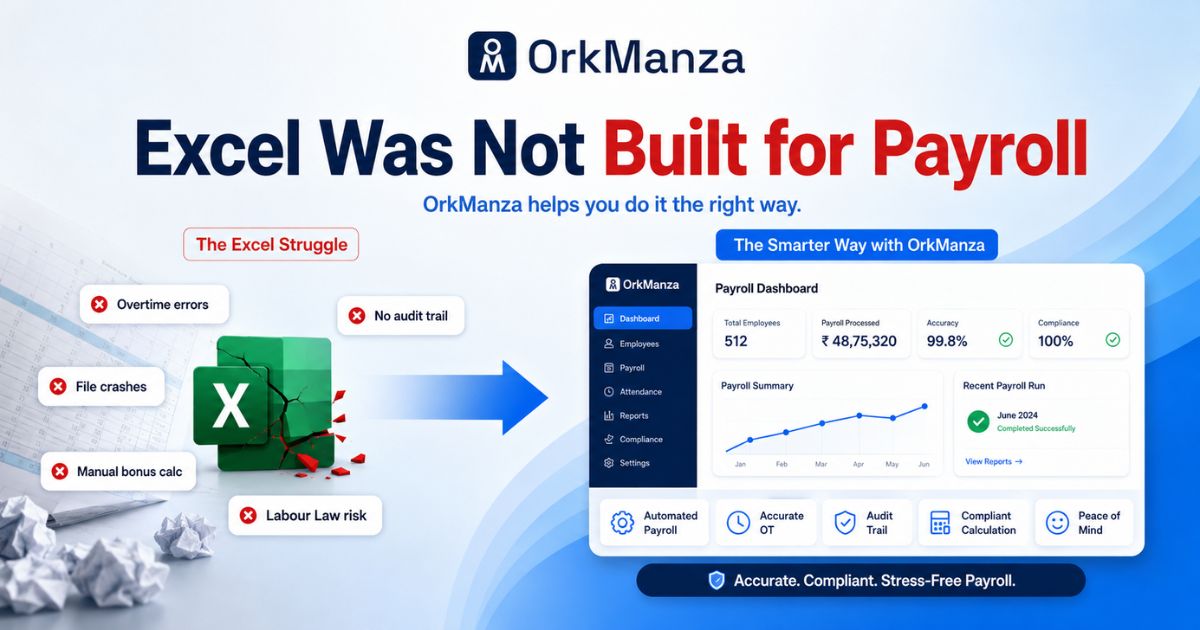
Common Problems of Excel-Based HR Management in Bangladesh
Here are the specific problems HR managers face every day in Bangladesh:
1. Payroll Mistakes Are Common
One formula error can create:
- Wrong salary
- Wrong overtime
- Wrong tax deduction
- Wrong bonus
This is one of the biggest Excel payroll problems for businesses in Bangladesh.
Example:
If one employee works 48 overtime hours and Excel calculates 38 instead of 48—
That creates:
- Salary disputes
- Legal issues
- Employee dissatisfaction
2. Overtime Calculation Errors
Under the Bangladesh Labor Act 2006, Section 108, overtime must be paid at twice the ordinary basic hourly rate calculated as (Basic Salary ÷ 208) × 2 × OT hours.
In Excel, this formula must be manually entered for every employee, every month. One wrong cell reference, one copied-over formula, and dozens of workers are underpaid or overpaid. In a garment factory with 400 workers across three shifts, this happens constantly.
3. Attendance Fraud Is Hard to Detect
Excel cannot track:
- Fingerprint attendance
- Geo attendance
- Shift timing
- Late entry
- Early exit
In Bangladesh, fingerprint attendance is now becoming standard in factories.
Excel cannot handle this.
4. Leave Management Gets Messy
Tracking:
- Casual leave
- Sick leave
- Annual leave
- Maternity leave
Manual is risky.
Especially under the Bangladesh labor regulations.
5. No Audit Trail
When a salary dispute happens, you need to prove what was calculated, when, and by whom. Excel has no audit trail. Files get overwritten, formulas get changed, and version history is unreliable.
6. No Real-Time Reporting
Excel reports are manual and time-consuming.
HR teams spend hours creating:
- Attendance reports
- Payroll reports
- Leave summaries
- Employee performance reports
With software?
These are instant, and some clicks make a perfect report.
7. Data Loss Risk
A single accidental deletion, a laptop crash, or a corrupted file can wipe months of HR records. Excel has no automatic backup, no role-based access, and no recovery system.
8. Scaling Breaks the System
A company that starts with 20 employees and grows to 150 finds its Excel file has become a 40-sheet monster that crashes, takes 10 minutes to open, and can only be edited by one person at a time.
Payroll Accuracy: Manual vs Automated HR Software
In manual payroll calculation, a typical HR team in Bangladesh takes 2–4 days to process salaries for 50 employees, including:
- Collecting attendance from the biometric export or register
- Cross-checking leave records
- Calculating overtime for each employee
- Adding/deducting allowances
- Applying income tax deductions
- Generating pay slips individually
- Checking for errors before approval
With OrkManza HR software, the same process takes under 30 minutes. Attendance is synced. Overtime is calculated. Tax deductions are applied automatically. Pay slips are generated in one batch. The main difference is accuracy and speed.
The difference isn't just time, it's accuracy. One HR manager at a leading garments company in Dhaka reported that "salary errors dropped to zero, and payroll now takes 10 minutes instead of 3 days" after switching to automated payroll.
Excel payroll risks:
- Formula mistakes
- Wrong overtime
- Missing deductions
- Tax errors
- Bonus miscalculations
HR software automatically calculates:
- Basic salary
- Overtime
- Tax
- Attendance deduction
- Leave deduction
- Festival bonus
HRM software significantly reduces payroll mistakes.
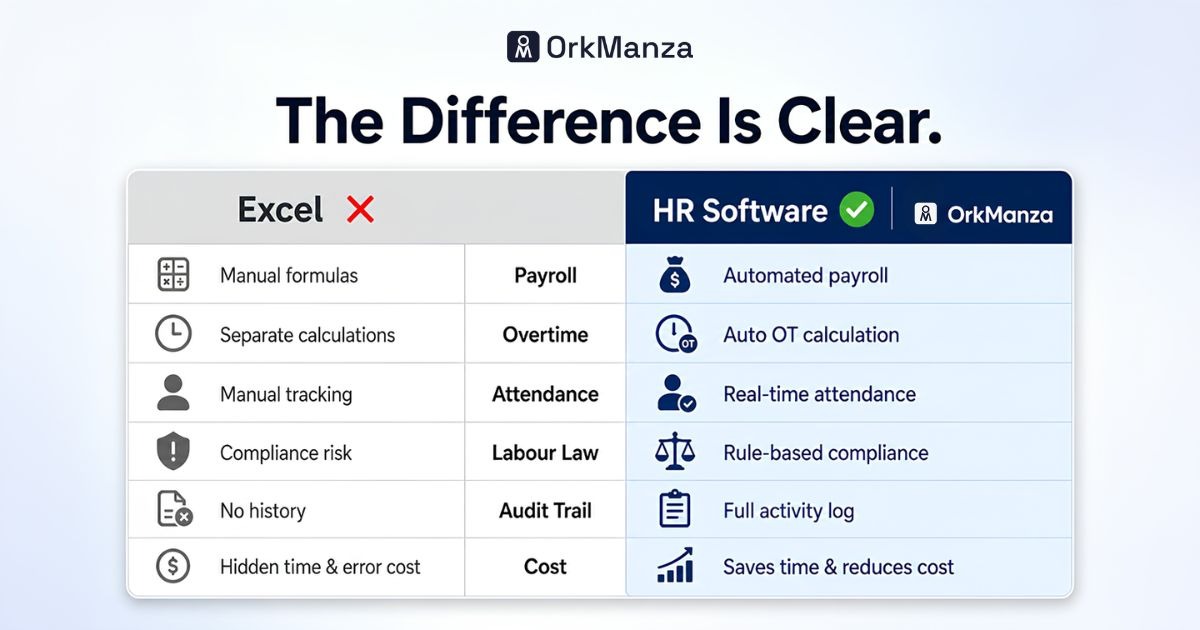
HR Software vs Excel — Full Comparison Table
| Feature | Excel | HR Software |
| Attendance Tracking | Manual | Automated |
| Fingerprint Integration | No | Yes |
| Payroll Calculation | Manual | Automated |
| Overtime Calculation | Risky | Accurate |
| Leave Management | Manual | Automated |
| Festival Bonus Calculation | Manual | Automatic |
| Shift Management | Hard | Easy |
| KPI Tracking | No | Yes |
| Reports | Manual | Real-Time |
| Employee Self-Service | No | Yes |
| Compliance Tracking | Weak | Strong |
| Security | Low | High |
Attendance Management: Fingerprint + Software vs Excel
The Excel problem
Many businesses in Bangladesh use ZKTeco or FingerTec biometric devices for attendance. But HR teams still export attendance logs to Excel for shift matching, overtime calculation, and payroll processing. This is still time-consuming manual work with a risk of errors.
- Takes 2–4 days
- Requires someone who knows both Excel and the biometric software
- Produces a separate file that must be merged with the payroll file
With Excel:
- Someone enters attendance manually.
- Errors happen
- Delays happen
- Fraud happens
The HR software solution
When biometric devices are connected to an HRMS like OrkManza, attendance data syncs automatically every day. The system knows which shift each employee is assigned to, so it calculates late arrivals, early departures, absences, and overtime in real time.
With HR software:
- Fingerprint attendance sync
- Mobile attendance
- Geo attendance
- Shift-wise attendance
- Real-time reports
This is why HR software, better than Excel, is becoming a major search trend in Bangladesh—because it removes manual work and reduces errors.
Leave Management: WhatsApp vs Workflow
Right now, in most Bangladeshi offices, leave requests happen over WhatsApp or email. The manager responds when they remember. HR updates a shared Excel sheet, maybe. Leave balances are guessed, not calculated.
This creates:
- Disputed leave balances at year-end
- Employees are unsure of how many leaves they have left.
- No record for Labor Law compliance (Section 115: 10 days annual leave, 14 days sick leave, 10 days casual leave for most workers)
Here, OrkManza HRM software gives employees a mobile app and enables them to apply for leave. Their manager gets a notification. One tap to approve. The balance updates automatically. Payroll adjusts accordingly if leave is unpaid. The record stays clean for any audit and supports compliance.
Productivity Impact: What Your HR Team Could Be Doing Instead
Manual payroll processing can consume 3–5 days every month, preventing HR teams from focusing on higher-value work such as talent acquisition, performance management, KPI tracking, employee development, and retention strategies.
Excel creates:
- Repetitive work
- Slow approvals
- Delayed reports
- Manual payroll
HR software creates:
- Faster workflows
- Better approvals
- Real-time dashboards
- Employee self-service
This improves:
- HR efficiency
- Team productivity
- Management visibility
These HRMS benefits help businesses in Bangladesh streamline HR operations, improve payroll accuracy, and increase workforce productivity.
Data Security and Reporting
Excel risks
- No password protection on most files
- Anyone with file access can edit historical records.
- No version control changes are invisible.
- Files stored on local laptops (lost, stolen, corrupted)
- No backup, one crash = months of lost data
HR software advantages
- Role-based access: HR manager, team manager, and employee each see only what they're allowed to.
- Encrypted cloud storage: data is backed up automatically
- Full audit trail: every change logged with user, timestamp, and reason
- Reports in one click: headcount, payroll cost, overtime hours, leave utilization, department-wise comparison
- Export to Excel or PDF: for accountants, auditors, or NBR submissions
Which Businesses in Bangladesh Should Switch in 2026?
You should switch now if:
- You have 30+ employees. Manual HR at this scale creates errors.
- You manage multiple shifts (A/B/C) in a factory or hospital.
- You have field staff across multiple locations or districts.
- You're a garments/RMG company facing buyer compliance audits.
- You've had payroll disputes or overtime complaints in the past year.
- Your HR team spends more than 2 days on payroll every month.
- You've had data loss from a corrupted or deleted Excel file.
- You're planning to scale from 50 to 100+ employees in 2026
Excel is still okay if:
- You have fewer than 15 employees.
- Your business is very early-stage (under 1 year)
- Your salary structure is extremely simple (one fixed salary, no overtime)
But even in these cases, switching early is cheaper than switching later because migrating 2 years of data is harder than migrating 6 months of data.
Conclusion: HR Software vs Excel Bangladesh
For many businesses in Bangladesh with more than 30 employees, replacing Excel with HR software may no longer be optional in 2026; it may be a business necessity.
Here is the honest comparison in one sentence: Excel organizes data. HR software runs your workforce.
HR software is better than Excel in Bangladesh when you need:
- Accurate, Labor Law-compliant payroll every month, automatically
- Overtime, bonus, and tax calculations that are audit-ready
- Attendance from biometric or mobile devices without manual entry
- Clean records for DIFE inspections and buyer compliance audits
- A mobile app your employees can use from anywhere
The switch is easier than you think, costs less than you're currently spending on manual HR, and pays for itself fast, often within the first month.
Try Orkmanza for Free
Automate HR, attendance, payroll, tasks and more. Track all your key metrics in one powerful platform.