
HR Software for NGOs in Bangladesh: Field Staff, Attendance & Payroll
HR & Payroll Software for NGOs in Bangladesh
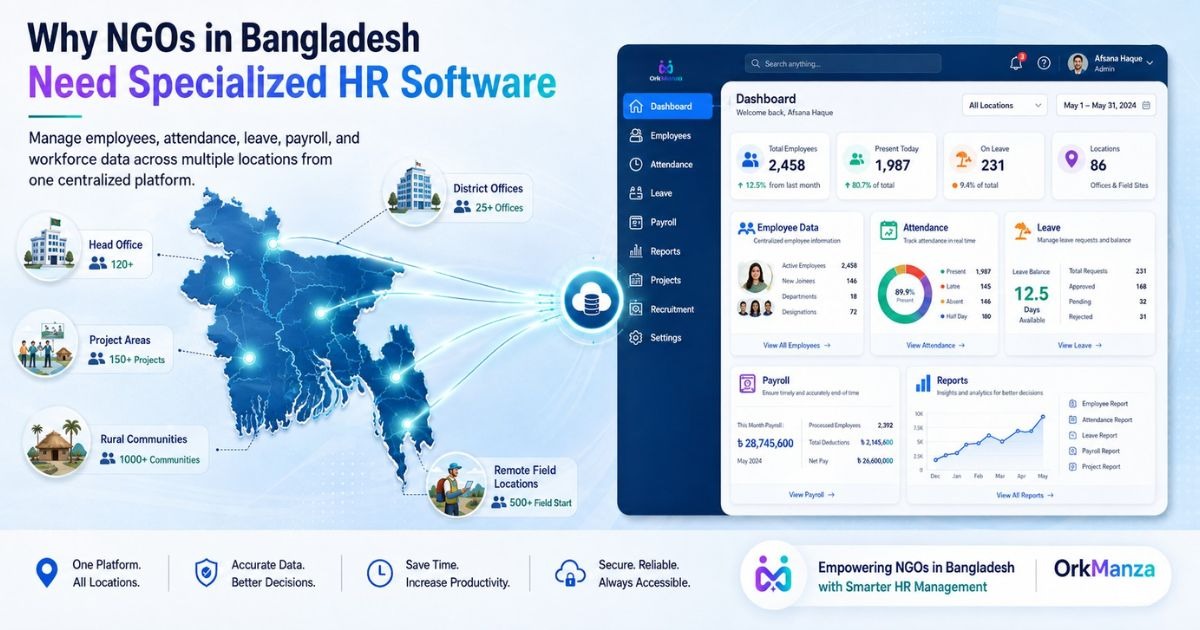
HR software for NGOs in Bangladesh
Key Takeaways
- Why NGOs in Bangladesh Need Specialized HR Software
- HR Challenges of NGO and Development Organizations
- Essential Features NGOs Should Look for in HR Software
- OrkManza vs Other HR Software Options for NGOs
- How NGOs Can Implement HR Software Successfully
- Common Mistakes NGOs Should Avoid When Choosing HR Software
- Future of HR Software for NGOs in Bangladesh
Introduction
NGOs and development organizations in Bangladesh often manage employees working in different locations. Some employees work from the head office, while others work in district offices, project areas, rural communities, disaster-response areas, or remote field locations.
A single organization may have permanent employees, project staff, consultants, contract workers, and temporary employees working across several districts. Managing such a diverse and distributed workforce can create many HR and workforce management challenges.
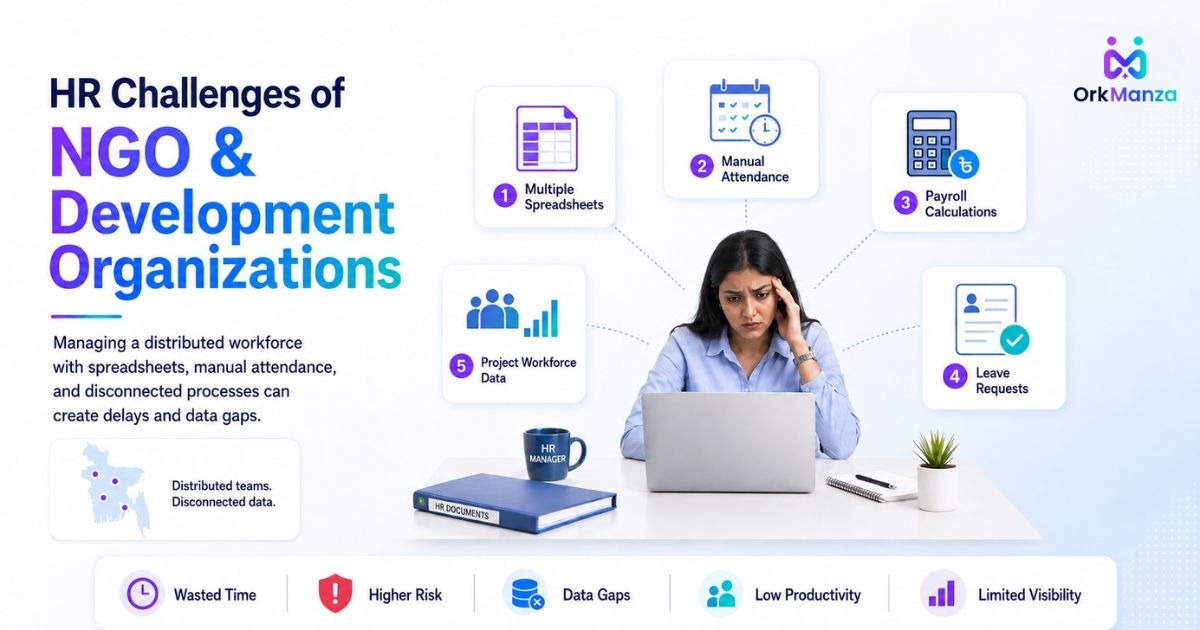
Many NGOs still rely on spreadsheets and manual processes to manage employee information. Attendance data may need to be collected from different offices, while field staff may submit manual timesheets. Leave requests and approvals may be handled through email, WhatsApp, or other messaging apps, making the entire process difficult to track and manage.
Payroll can also become complicated. HR and finance teams may need to manage different types of employees, salary structures, allowances, deductions, and project-based workforce information. Collecting all this data manually can take time and increase the risk of errors.
For organizations running donor-funded projects, properly organized employee and workforce records are also important. Accurate records can support internal reporting, audit preparation, and required documentation.
This is where HR Software for NGOs in Bangladesh can be highly useful.
A modern cloud-based HRIS, payroll, and workforce management system can help NGOs manage employee data, attendance, leave, payroll, approvals, and reporting from a single central platform. Instead of using multiple spreadsheets, paper documents, and separate communication channels, organizations can manage important HR information more effectively and efficiently.
For NGOs with employees working in different locations, NGO HR software in Bangladesh can also make field staff management software more practical. HR teams can maintain employee records, track attendance, manage leave requests, and support payroll processing without collecting information separately from every office or project location.
Platforms such as OrkManza can help organizations consolidate HR, attendance, payroll, employee records, and workforce management into a single cloud-based system. This can make it easier for NGOs and development organizations to manage their employees, reduce manual work, and maintain better visibility across their workforce.
Why NGOs in Bangladesh Need Specialized HR Software
As an NGO grows, manual HR processes often become increasingly difficult to manage.
A small organization may initially handle employee information through spreadsheets and maintain attendance records separately. However, when the organization expands into multiple projects and locations, this approach can create operational gaps.
Common problems include:
Fragmented Employee Data
Employee information is often stored in different places. For example, the HR team may keep the employee contract, the Finance team may have bank details, and project information may be stored in separate files. Important documents, such as National ID copies, may also be saved in different folders.
As a result, finding all the information about a single employee can take a long time. Preparing a project staffing list or employee report for management or a donor may require HR staff to collect data from several different sources.
Manual Attendance
Many NGOs still collect attendance manually. Field offices may send attendance sheets to the head office through email or other methods.
By the time payroll is prepared, some attendance records may be missing or incomplete. HR teams may then need to contact employees or managers to correct the information. This can delay the payroll process and create extra work.
Payroll Errors
Manual payroll processing can increase the risk of mistakes. Salary changes, leave without pay, new employees joining mid-month, and other changes may require manual calculation.
Even small mistakes can create problems for employees and require additional time to correct. Accurate payroll records are also important during internal reviews and audits.
Delayed Approvals
In many organizations, a leave request may go through several people before it is approved. A field employee may contact a supervisor, then the request may go to a district coordinator, and finally to the HR team.
When requests are handled via phone calls, emails, and WhatsApp messages, it can be difficult to track approval status. An NGO HR software solution in Bangladesh can help centralize leave requests and approvals.
Limited Workforce Visibility
Management may sometimes need simple information, such as how many employees are working on a specific project or how many staff members are assigned to a particular location.
When employee data is stored in different spreadsheets and files, preparing this information can take time and require manual work.
An HRIS or NGO workforce management software does not solve every organizational problem. However, it can reduce the need to manually collect and combine information. By centralizing employee data, attendance, leave, and payroll information, HR and Finance teams can spend less time searching for data and more time managing people and making better decisions.
HR Challenges of NGO and Development Organizations
Managing Field Staff Across Multiple Locations
NGOs frequently operate across multiple districts and project locations.
Field officers, community facilitators, coordinators, supervisors, and project staff may spend most of their working time outside the head office.
This makes traditional office-based attendance systems less suitable.
HR teams need a practical way to understand:
- Who is assigned to which location?
- Which employees are working on different projects
- Whether attendance records have been submitted
- Who is on leave
- Which employees are assigned to particular shifts or rosters
A centralized field-staff management software platform can reduce reliance on separate spreadsheets at every office or project location.
Tracking Attendance Outside the Head Office
Field employees may not have access to a biometric device or fixed office attendance system.
In these situations, organizations may use mobile attendance or geo-based attendance features where appropriate.
A field employee attendance software system can help employees record attendance through approved digital workflows rather than relying entirely on paper registers or manually submitted timesheets.
However, location-based attendance should always be implemented carefully.
Organizations should establish clear policies regarding:
- What location information is collected
- When location data is collected
- Who can access the information?
- How long are records retained?
- How employee privacy is protected
Technology should support organizational policy rather than replace it.
Managing Project-Based Employees
Development organizations often manage employees assigned to specific projects.
A project may have a defined duration, specific locations, different staffing requirements, and temporary employment arrangements.
This can make workforce planning more complex.
HR teams may need to manage:
- Contract start and end dates
- Project assignments
- Employee roles
- Temporary staff
- Renewals
- Transfers
- Project-based workforce information
A centralized employee database can make it easier to maintain structured records instead of searching through multiple spreadsheets or folders.
Handling Complex Payroll Operations
Payroll management for NGOs can involve different employee categories and compensation structures.
Depending on organizational policies, payroll may include:
- Basic salary
- Allowances
- Attendance-related adjustments
- Over time, where applicable
- Leave adjustments
- Deductions
- Contract-based payment structures
Manual payroll processing can require HR and finance teams to repeatedly collect attendance, leave, and employee information from different sources.
A structured NGO payroll software solution in Bangladesh can help reduce repetitive manual work and improve consistency in payroll records.
Organizations should still ensure that their payroll setup reflects their own employment policies, applicable legal requirements, and internal finance processes.
Maintaining Accurate Employee Records
Employee information can change over time.
Employees may change:
- Job title
- Department
- Project
- Work location
- Manager
- Contract status
- Contact information
When this information is stored across multiple files, maintaining accuracy can become difficult.
An employee management software platform in Bangladesh can centralize employee profiles and make relevant workforce information more accessible.
Managing Leave and Approvals
Manual leave processes can create confusion.
Employees may submit requests through email, messaging applications, or paper forms. Managers may approve requests through different channels, making it difficult to maintain a complete record.
A centralized leave management software Bangladesh solution can create a more structured workflow for:
- Leave requests
- Approval routing
- Leave balances
- Leave history
- Manager visibility
Preparing HR Data for Reporting and Audits
NGOs may need workforce information for management reporting, project administration, internal review, or audit preparation.
When HR information is fragmented, preparing reports can take significant time.
Centralized systems can help organizations maintain more structured access to:
- Employee records
- Attendance history
- Leave records
- Payroll documentation
- Approval records
- Workforce reports
This does not remove the need for organizational policies, controls, or proper documentation procedures. However, it can make relevant workforce records more accessible.
Essential Features NGOs Should Look for in HR Software
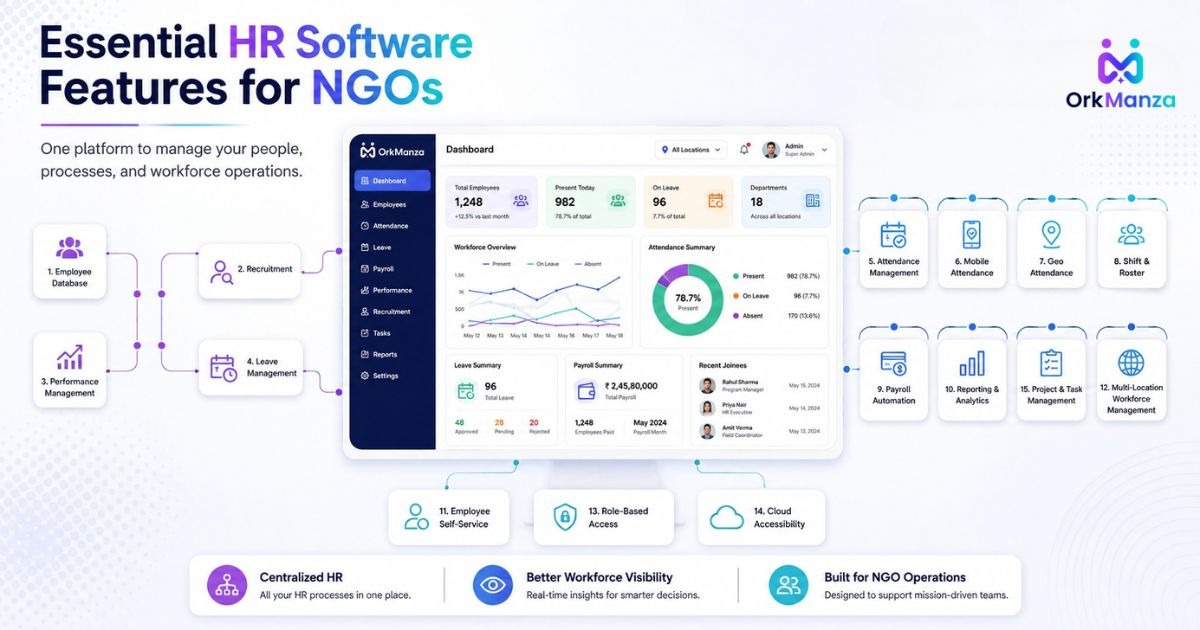
When evaluating the best HR software for NGOs, organizations should look beyond basic employee records.
1. Centralized Employee Database
A centralized employee database helps maintain consistent workforce information across departments, projects, and locations.
2. Attendance Management
Organizations should be able to define attendance processes suitable for office-based and field employees.
3. Mobile Attendance
Mobile functionality can support employees working outside traditional office environments.
4. Geo Attendance
Geo attendance can support location-based verification when appropriate and consistent with organizational policy.
5. Payroll Automation
Payroll automation can reduce repetitive calculations and help centralize salary records.
6. Leave Management
Employees and managers should have a clear workflow for submitting, approving, and tracking leave.
7. Employee Self-Service
Self-service features can reduce HR administrative workload by allowing employees to handle routine requests directly.
8. Shift and Roster Management
This is useful for organizations with rotating schedules, field coverage requirements, or location-based shifts.
9. Recruitment Management
Recruitment tools can help manage job vacancies, candidates, and hiring workflows.
10. Performance Management
Performance and KPI management can help organizations structure employee performance reviews.
11. Reporting and Analytics
HR teams should be able to review workforce information without manually combining multiple spreadsheets.
12. Multi-Location Workforce Management
The system should support employees working across different districts, offices, and project locations.
13. Role-Based Access
Not every employee should have access to all workforce information.
Role-based permissions can help organizations define appropriate access levels.
14. Cloud Accessibility
A cloud HR software solution in Bangladesh can make workforce information more accessible to authorized users across locations.
15. Project and Task Management
For project-driven organizations, task and project management can help connect workforce coordination with daily operations.
OrkManza vs Other HR Software Options for NGOs
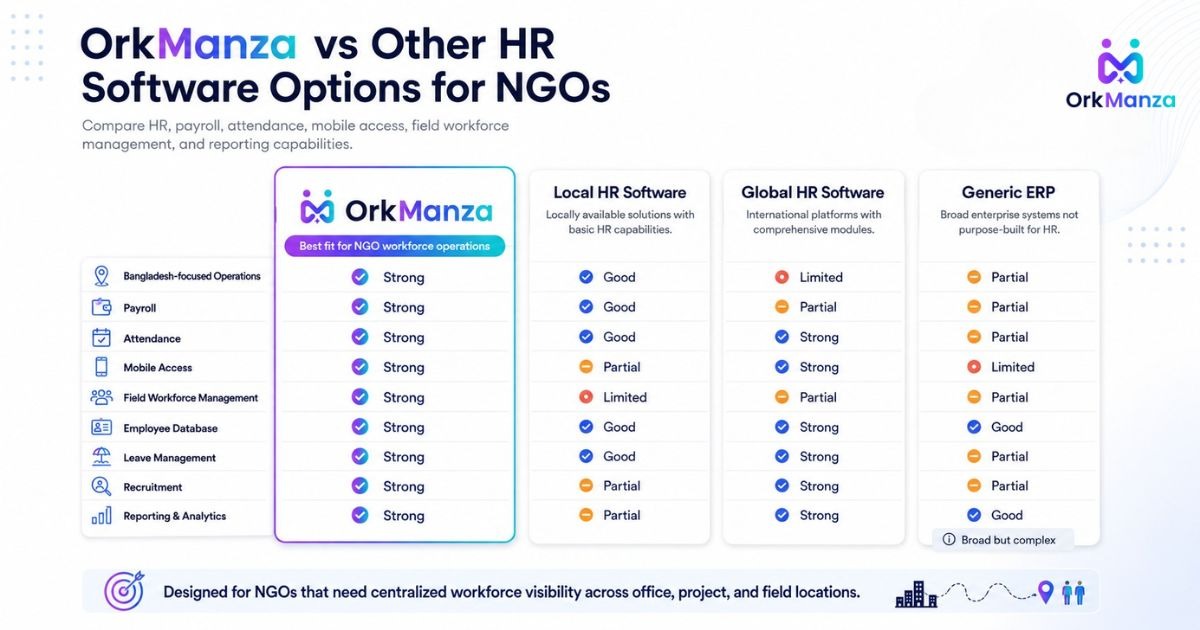
NGOs in Bangladesh have several types of software options available.
These may include local HR software providers, global HRIS platforms, and generic ERP systems.
| Feature | OrkManza | Local HR Software | Global HR Software | Generic ERP |
|---|---|---|---|---|
| Bangladesh-focused operations | Designed for local organizational needs | Varies by provider | May require localization | Often requires configuration |
| Payroll flexibility | Supports payroll management workflows | Varies | Depends on local support and configuration | May require customization |
| Attendance management | Available | Usually available | Varies by platform | May require modules |
| Mobile access | Mobile application available | Varies | Often available | Depends on the provider |
| Field workforce management | Supports mobile and geo attendance features | Varies | Depends on the platform | May require customization |
| Employee database | Available | Usually available | Available | Available with configuration |
| Leave management | Available | Usually available | Available | Available with modules |
| Recruitment support | Available | Varies | Often available | May require additional modules |
| Reporting and analytics | Available | Varies | Usually advanced | Depends on implementation |
| Local implementation | Available | Depends on the provider | Depends on regional support | Can be implementation-intensive |
| Customization | Depends on organizational requirements | Varies | Can be limited or complex | Often flexible but more complex |
| NGO operational suitability | Relevant for organizations needing integrated HR and workforce features | Depends on the product | Depends on localization and requirements | Depends heavily on customization |
How NGOs Can Implement HR Software Successfully
Software implementation should be treated as an operational improvement project rather than simply an IT installation.
Step 1: Audit Existing HR Processes
Identify how employee records, attendance, leave, payroll, and approvals are currently managed.
Step 2: Centralize Employee Data
Review and clean employee information before importing it into the new system.
Step 3: Configure Attendance Policies
Define attendance rules for head-office employees, district staff, and field teams.
Step 4: Set Up Leave Workflows
Configure leave types, approval processes, and employee eligibility in accordance with organizational policy.
Step 5: Configure Payroll Processes
Set up salary structures and payroll workflows in accordance with the organization's approved policies and applicable requirements.
Step 6: Train HR and Employees
Even good software can fail if employees do not understand how to use it.
Provide clear training for:
- HR teams
- Managers
- Payroll teams
- Field supervisors
- Employees
Step 7: Start With a Pilot Team
Instead of immediately moving the entire organization into a new system, begin with a pilot group or project.
Identify issues and improve workflows before wider implementation.
Step 8: Review Reports and Improve Workflows
After implementation, review whether the system is actually improving HR operations.
Look for:
- Missing data
- Delayed approvals
- Attendance exceptions
- Payroll issues
- User adoption problems
Common Mistakes NGOs Should Avoid When Choosing HR Software
Choosing the right HR software is an important decision for any NGO. The wrong system can create extra work instead of making HR operations easier. Here are some common mistakes NGOs should avoid:
Choosing Software Only Based on Price
The cheapest software is not always the best option. A low-cost system may become expensive if it does not support field employees, payroll requirements, or mobile access. If HR still needs to maintain separate spreadsheets, the organization is not getting the full benefit of the software.
Ignoring Mobile Access
For NGOs with many field employees, mobile access can be very important. Field staff may need to mark attendance, apply for leave, or access basic HR information without visiting the head office.
Before choosing a system, NGOs should check whether the mobile experience is simple and practical for field employees.
Evaluating the Software Only From the Head Office
A software demo should not include only senior management or HR leaders.
It is a good idea to involve people who will use the system regularly, such as a regional coordinator, field officer, or project manager. They may identify practical problems that are not visible from the head office.
Choosing a System That Is Too Complex
Some large enterprise platforms offer many advanced features. However, an NGO may not need all of them.
A complex system can take longer to implement, require more training, and be difficult for employees to use. It is better to choose software that matches the organization’s actual needs and HR capacity.
Not Checking Local Payroll Requirements
Before selecting HR and payroll software for NGOs, organizations should check whether the system can support their payroll structure.
For example:
- Different salary structures
- Allowances and deductions
- Different employee types
- Project-based employees
- Payroll reporting requirements
These requirements should be discussed with the software provider before making a final decision.
Skipping the Implementation and Training Plan
Buying software is only the first step. NGOs also need a clear implementation plan.
The organization should prepare for:
- Employee data migration
- System setup
- HR and employee training
- Testing
- Payroll verification during the transition period
A proper onboarding plan can help reduce problems during implementation.
Not Defining User Permissions
Employee and payroll information can be sensitive. NGOs should decide who can access different types of data before the system goes live.
For example, the organization should clearly define who can access:
- Employee personal information
- Salary and payroll data
- Attendance records
- Location-related information
- HR reports
Role-based access can help protect sensitive information.
Not Planning Reporting Needs in Advance
Before choosing a system, NGOs should list the reports they need regularly.
These may include:
- Employee reports
- Attendance reports
- Leave reports
- Payroll reports
- Project workforce reports
- Management reports
The organization should confirm that the software can provide the information needed for internal management, project operations, and reporting.
Ignoring Data Export and Portability
NGOs should also check what happens to their data if they change software providers in the future.
Before purchasing, ask whether the organization can export important information, such as:
- Employee records
- Attendance history
- Leave records
- Payroll data
- Reports
It is also important to understand how data will be handled when the software contract ends.
By avoiding these common mistakes, NGOs can choose HR Software for NGOs in Bangladesh that better fits their workforce, field operations, payroll processes, and long-term requirements.
Future of HR Software for NGOs in Bangladesh
The future of HR technology for NGOs in Bangladesh is becoming more practical and digital. Cloud-based HR software is making it easier for organizations to manage employees without depending on separate servers, paper files, or multiple spreadsheets.
As smartphone use continues to grow, more NGOs can use mobile-based HR tools for daily tasks. Employees, especially field staff, can use mobile apps to manage attendance, apply for leave, view payslips, and submit expense-related information where needed.
Paper-based attendance and manual timesheets are also gradually being replaced by digital systems. This can help NGOs keep employee and workforce records more organized and easier to access.
Automation will also play an important role. Routine tasks such as payroll calculations, leave tracking, and approval workflows can be automated. This can reduce manual work and allow HR teams to spend more time on important areas such as recruitment, employee development, and workforce planning.
With accurate and organized employee data, NGOs can also better understand their workforce needs. They can review staffing information, plan employee requirements for future projects, and prepare workforce reports more easily.
One of the biggest benefits will be centralized reporting. Instead of collecting information from multiple spreadsheets and offices, management can access key HR and workforce data from a single central system.
Overall, the future of HR Software for NGOs in Bangladesh will focus on cloud technology, mobile access, automation, and better workforce reporting. The goal is not to make HR processes more complicated, but to help NGOs manage employees and field teams more simply, quickly, and more effectively.
Frequently Asked Questions
The best HR software for NGOs should support employee management, attendance, leave, payroll, field staff tracking, reporting and workforce management. A centralized HR platform can help NGOs manage both office-based and field employees more efficiently.
HR software can help NGOs track field staff attendance, verify check-ins, manage leave, assign tasks and monitor workforce information from a centralized platform. GPS and mobile attendance can be particularly useful for employees working across different project locations.
Yes. HR platforms with mobile GPS attendance allow field employees to check in from their assigned work locations while recording location information. Geo-fencing can also restrict attendance to approved locations, helping organizations verify field attendance more effectively.
Yes. An integrated payroll system can use attendance, leave and approved overtime information to streamline payroll calculations. This can reduce manual data entry and help HR and finance teams process salaries more efficiently.
NGOs should consider features such as employee database management, GPS/mobile attendance, leave management, payroll automation, field staff management, task tracking, employee self-service, performance tracking and real-time reporting. The right combination depends on the NGO's workforce structure and operational requirements.
Try OrkManza for Free
Automate HR, attendance, payroll, tasks and more. Track all your key metrics in one powerful platform.