
HR Software for Hospitals - Shift, Payroll & Compliance Guide
HR Software for Hospitals in Bangladesh: Complete Guide
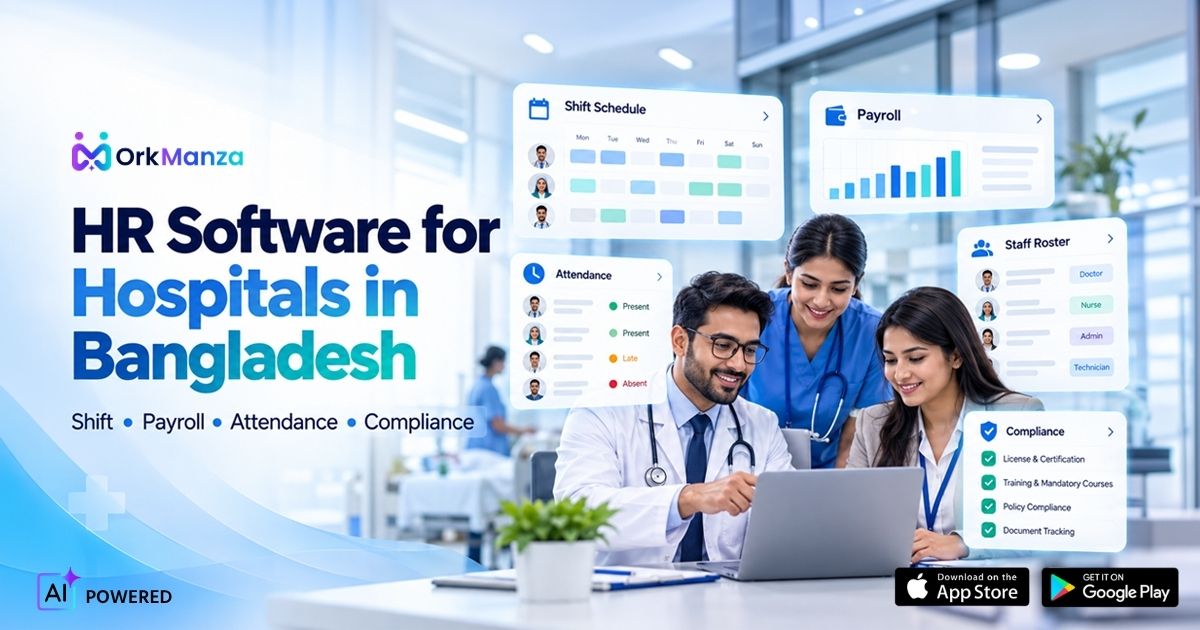
Hospital HR Software in Bangladesh
Key Takeaways
- What Is HR Software for Hospitals?
- Why Do Hospitals Need Specialized HR Management Software?
- Unique HR Challenges of Hospitals in Bangladesh
- Key Features of HR Software for Hospitals in Bangladesh
- Shift & Roster Management Software for Hospitals
- Payroll Management for Hospitals in Bangladesh
- Why Hospitals Should Move from Excel to HR Software
- Benefits of Using OrkManza AI-Powered HR Software in Hospitals
- How to Choose the Best HR Software for a Hospital in Bangladesh
Running a hospital means running 24 hours a day, seven days a week. HR software for hospitals in Bangladesh helps administrators manage the people side of that reality: rotating shifts, nurse rosters, doctor schedules, overtime, leave, payroll, and employee records, all in one system instead of scattered spreadsheets and paper registers.
The hospital management pressure is real. A single hospital may employ consultants on visiting schedules, resident doctors on night duty, nurses on three rotating shifts, lab technicians, pharmacists, front-desk staff, ward boys, cleaners, and security guards. Each group has different working hours, pay structures, and attendance patterns. Managing all of this manually leads to payroll disputes, understaffed wards, and weak audit trails.
This guide will explain what hospital HR software does, how it handles shifts and payroll, what to check for compliance, how to choose a system, and how to implement it. It is written for hospital owners, HR managers, administrators, and finance teams in Bangladesh.
What Is HR Software for Hospitals?
The best HR software for hospitals is a system that manages employee data, attendance, shift rosters, leave, payroll, and HR reporting for healthcare organizations. It is also called a hospital HR management system (HRMS), or healthcare workforce management software.
A general HR tool treats every employee the same. Hospital HR software is configured for the way healthcare actually works: staff on 8-hour or 12-hour rotating shifts, night duty allowances, on-call doctors, variable overtime, and frequent last-minute roster changes.
In practice, it connects four things that are usually handled separately:
- Who is employed, in which department, on what terms
- Who worked, when, and for how long
- Who is scheduled to work next?
- How much each person should be paid, and why
When these four are linked, an attendance record flows into the roster check, then into overtime, then into the payslip, with no retyping.
Why Do Hospitals Need Specialized HR Management Software?
A hospital can have employees working during the day, evening, night, weekends, holidays, and emergency shifts. Some employees may follow fixed schedules, while others may rotate between different shifts.
This creates several HR challenges.
1. 24/7 Operations
Hospitals cannot treat HR attendance as in a conventional 9-to-5 office environment. Workforce availability must be continuously planned.
2. Multiple Employee Categories
A hospital may employ:
- Doctors
- Nurses
- Medical officers
- Technicians
- Pharmacists
- Administrative employees
- Receptionists
- Billing staff
- Security personnel
- Cleaners and maintenance workers
- Other support employees
Each group may have different working patterns and payroll structures.
3. Shift-Based Attendance
A simple "present/absent" system may not provide enough information. HR teams may need to know which employee worked which shift, whether they arrived late, whether they worked overtime, and whether they completed their assigned schedule.
4. Complex Payroll
Hospital payroll can involve basic salary, allowances, overtime, deductions, bonuses, attendance information, leave records, and other salary components.
5. Frequent Leave and Schedule Changes
Healthcare employees may need leave or schedule adjustments. Managing these changes manually can create conflicts in rosters and payroll.
6. Employee Documentation
Hospitals need organized employee records and documentation so HR teams can quickly retrieve information when required.
7. Reporting and Audit Readiness
Management may need reports on attendance, payroll costs, overtime, employee numbers, leave balances, and workforce distribution.
Excel can handle some of these tasks. The problem arises when the workforce grows, schedules become more complex, and multiple people need to access and update the same information.
Unique HR Challenges of Hospitals in Bangladesh
Hospitals everywhere face complex staffing challenges, but several are especially common in the Bangladeshi context.
Large mixed workforces: Even a mid-sized private hospital can combine permanent staff, contract staff, visiting consultants, outsourced security, and cleaning teams. Each category needs different attendance and pay logic.
Visiting and part-time doctors: Many consultants attend on fixed days, per-visit or per-session arrangements. Their payment does not follow a standard monthly salary pattern.
Heavy reliance on overtime: Staff shortages and patient surges often mean extended duty hours. Accurately tracking and approving overtime is a constant task.
Multiple branches and units: Hospital groups, diagnostic chains, and clinics with several branches need consolidated HR data without losing branch-level control.
Mixed record-keeping habits: Many facilities still run a combination of biometric devices, paper registers, and Excel files. The data does not match across them.
Payroll complexity: Basic salary, house rent, medical and transport allowances, night duty allowances, festival bonuses, advance recovery, and tax deductions all appear in a single month's payroll.
Key Features of HR Software for Hospitals in Bangladesh
The best hospital HR software should provide more than attendance and payroll. A modern HRMS should connect the major stages of the employee lifecycle.
1. Employee Database
A centralized employee database allows HR teams to maintain employee profiles in one place.
Typical information may include:
- Employee name and contact information
- Employee ID
- Department
- Designation
- Joining date
- Employment type
- Salary information
- Reporting manager
- Documents
- Emergency contact
- Employment history
Instead of searching through paper files or multiple spreadsheets, authorized HR users can access the required record from a central system.
2. Attendance Management
Hospital attendance software should support different attendance methods and working patterns.
Depending on the organization's requirements, attendance may be collected through:
- Biometric devices
- Mobile attendance
- Web-based attendance
- GPS/geo attendance
- Shift-based attendance
The system should ideally connect attendance information with payroll and overtime calculations.
3. Shift & Roster Management
Shift management is one of the most important requirements for hospitals.
The system should help HR and department managers create, assign, modify, and monitor employee rosters.
A useful system should support:
- Day shifts
- Night shifts
- Rotating shifts
- Department-based rosters
- Nurse scheduling
- Doctor scheduling
- Emergency staffing
- Overtime
- Shift changes
- Shift swapping
- Late and early attendance
More details are discussed below.
4. Payroll Management
Hospital payroll software should allow salary calculations to use relevant employee and attendance information.
Depending on the organization's payroll structure, this can include:
- Basic salary
- Allowances
- Overtime
- Bonuses
- Deductions
- Attendance-based adjustments
- Leave-related adjustments
- Tax-related calculations
- Payslips
- Payroll reports
The exact payroll rules should be configured in accordance with the organization's approved policies and applicable requirements.
5. Overtime Calculation
Overtime is particularly important in shift-based environments.
A hospital HRMS can link approved overtime records to payroll, so HR teams do not have to manually calculate overtime for every employee.
However, the software should be configured in accordance with the organization's applicable policies and legal requirements, rather than assuming a universal overtime formula.
6. Leave Management
Instead of managing leave applications through paper forms, email, or messaging applications, employees can submit requests through the HR system.
HR and managers can then:
- Review requests
- Approve or reject leave.
- Monitor leave balances
- Maintain leave history
- Connect approved leave information with payroll.
7. Recruitment
Hospitals regularly need qualified employees across different departments.
Recruitment functionality can help manage:
- Job vacancies
- Candidate information
- Applications
- Interview stages
- Hiring decisions
- Employee onboarding
8. Employee Self-Service
Employee Self-Service, or ESS, reduces routine HR queries.
Employees may be able to:
- View attendance
- Apply for leave
- View leave balances
- Download payslips
- Update selected personal information.
- Submit expenses
- Receive notifications
This allows HR teams to spend less time answering repetitive administrative requests.
9. Performance Management
Hospitals can use KPI and performance-management functionality to establish structured evaluation processes for different employee groups.
The KPIs for a nurse, technician, administrative employee, or support worker will not necessarily be identical, so configurable performance criteria are useful.
10. Task Management
HR platforms increasingly include task management features, allowing managers to assign and monitor employee-related work.
This can be useful for administrative departments and operational teams where workforce management extends beyond attendance and payroll.
11. Expense Management
Employees may need to submit approved business expenses.
An expense module can provide:
- Digital expense claims
- Receipt uploads
- Approval workflows
- Expense history
- Reimbursement tracking
12. Reports & Analytics
Management should be able to convert HR data into useful information.
Examples include:
- Attendance reports
- Payroll reports
- Overtime reports
- Employee headcount
- Leave reports
- Department-wise workforce reports
- Recruitment reports
- Performance reports
13. Mobile App
A mobile HR application can be particularly useful for employees and managers who are not always sitting at a desk.
Employees can access relevant HR services, while managers can review requests and workforce information remotely.
14. Geo Attendance
For organizations with multiple locations or employees who work outside a fixed office environment, geo attendance can add location-based controls to attendance processes.
15. Notifications and Alerts
Automated notifications can help employees and managers stay informed about:
- Leave approvals
- Attendance issues
- Shift changes
- Payroll availability
- Pending approvals
- HR announcements
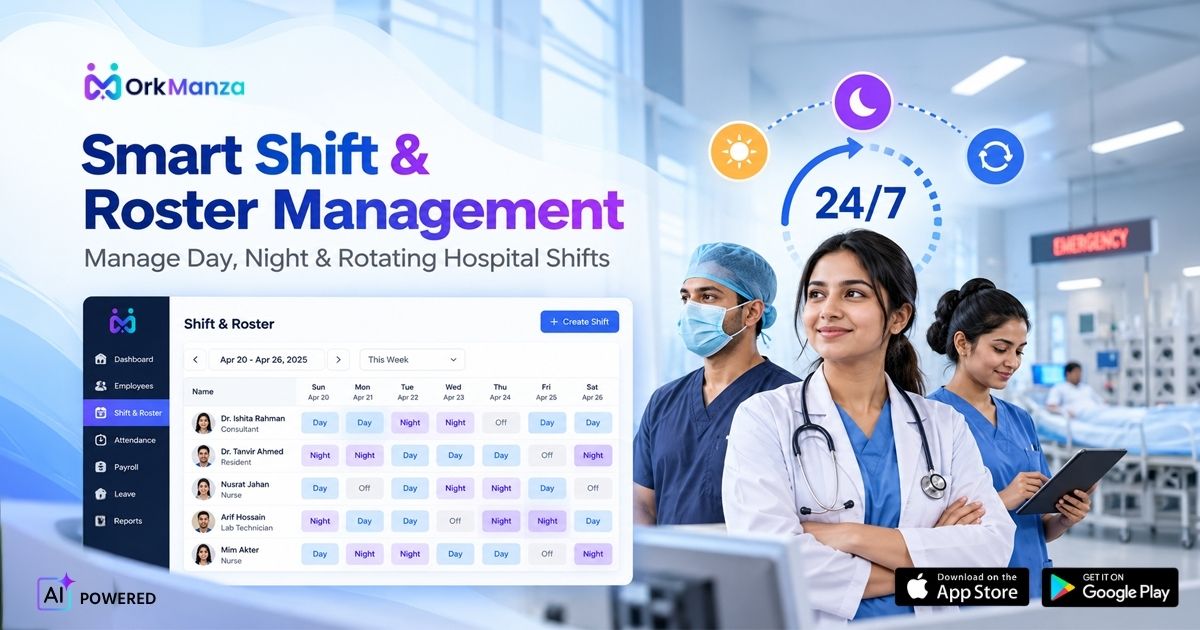
Shift & Roster Management Software for Hospitals
For many hospitals in Bangladesh, shift and roster management is the most critical HR function after employee records and payroll.
A roster determines who is expected to work, where, and for how long.
A hospital may have several departments operating simultaneously. Emergency, ICU, laboratory, pharmacy, nursing, reception, security, and other functions may have different staffing requirements.
A proper shift management system should therefore make scheduling structured rather than dependent on individual spreadsheets.
Day and Night Shifts
Hospitals can configure different shifts according to operational requirements.
For example:
- Morning/day shift
- Evening shift
- Night shift
- Extended shift
- Emergency shift
The actual working hours should be defined in accordance with the hospital's approved policies.
Rotating Shifts
Some employees may rotate between different schedules.
A shift management software system can help managers plan these rotations while maintaining a clear history of assigned shifts.
Nurse Scheduling
Nursing teams often require detailed scheduling because departments need sufficient staffing at different times.
Managers can use roster information to identify:
- Who is scheduled
- Which department they are assigned to
- Which shift are they working?
- Who is absent
- Where replacement coverage may be required
Doctor Scheduling
Doctors may have different duty patterns, work in different departments, and have varying availability.
A centralized roster can provide better visibility into assigned schedules and help reduce scheduling conflicts.
Emergency Department Staffing
Emergency departments require particular attention because staffing needs may differ from those of normal departments.
A digital roster can help managers quickly see expected staffing levels and identify gaps before a shift begins.
Overtime
When employees work beyond their scheduled hours, approved overtime records can be connected to payroll.
This creates a more traceable process than manually entering overtime figures into a payroll spreadsheet.
Shift Swapping
Hospitals may allow employees to request shift changes or swaps, subject to management approval.
A digital workflow can record:
Employee request → Manager approval → Updated roster → Attendance → Payroll
This is considerably easier to audit than informal changes made through messages or verbal communication.
Late and Early Attendance
The system can compare scheduled working hours with actual attendance information.
This can help HR identify:
- Late arrivals
- Early departures
- Missing punches
- Attendance exceptions
- Unapproved absences
Avoiding Understaffing and Scheduling Conflicts
One of the practical advantages of digital roster management is visibility.
Before publishing a roster, managers can review employee assignments and identify obvious conflicts, duplicate assignments, missing coverage, or unavailable employees.
The software does not replace management judgment. Instead, it gives managers better information for making staffing decisions.
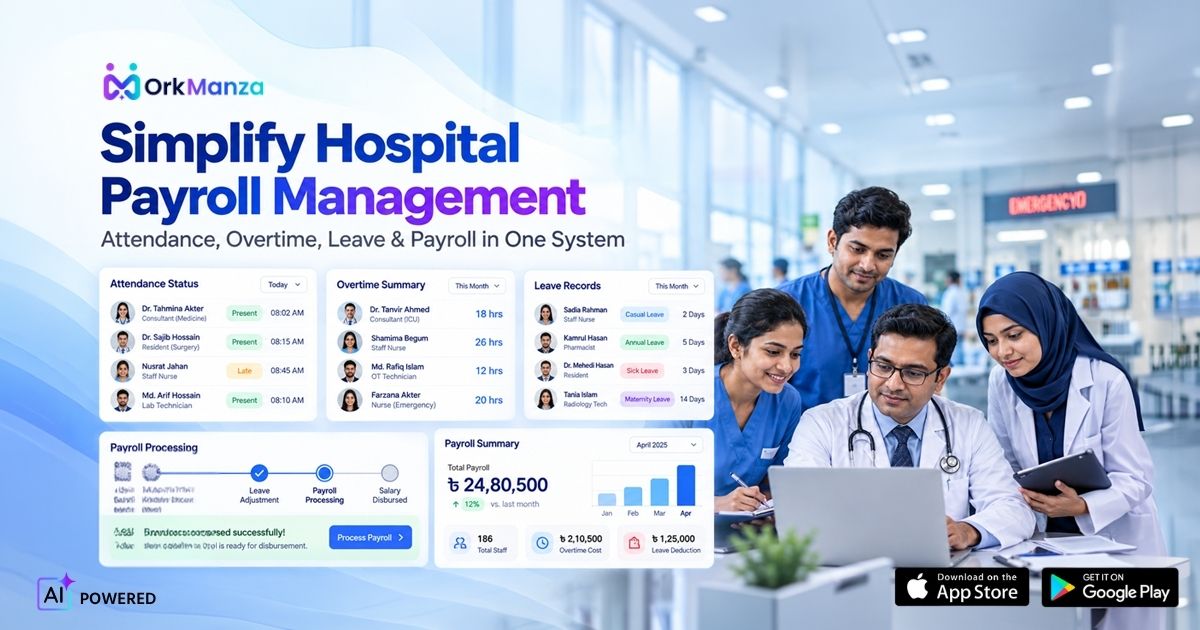
Payroll Management for Hospitals in Bangladesh
Hospital payroll management converts attendance, leave, overtime, and salary data into accurate monthly pay. In hospitals, this is harder than in most offices because pay components vary by role and shift.
OrkManza HR software can manage these components:
- Basic salary and allowances: House rent, medical, conveyance, and special or night duty allowances, each configured per grade or role.
- Overtime: Calculated from approved overtime hours using hospital rate rules.
- Deductions: Late penalties (if policy allows), advance recovery, loan installments, provident fund contributions, and other approved deductions, so payroll stays controlled and compliant with policy.
- Bonuses: Festival bonuses, performance incentives, and one-off payments, helping hospitals handle additional pay without manual adjustments.
- Attendance-based salary: Absences and unpaid leave automatically reduce pay based on recorded data, reducing errors and manual work.
- Leave deductions: Unpaid leave days are pulled from the leave module rather than re-entered, helping keep payroll data consistent.
- Tax-related calculations: The monthly tax deduction at source can be configured in accordance with applicable rules. Always confirm current rates and slabs with the National Board of Revenue (NBR) or a qualified tax professional to ensure payroll remains aligned with current guidance.
- Payslips: Generated for each employee with a clear breakdown and available digitally, making pay details easier to review.
- Payroll reports: Department-wise costs, overtime costs, bank transfer sheets, and summaries for finance and audit, delivering the reports teams need faster.
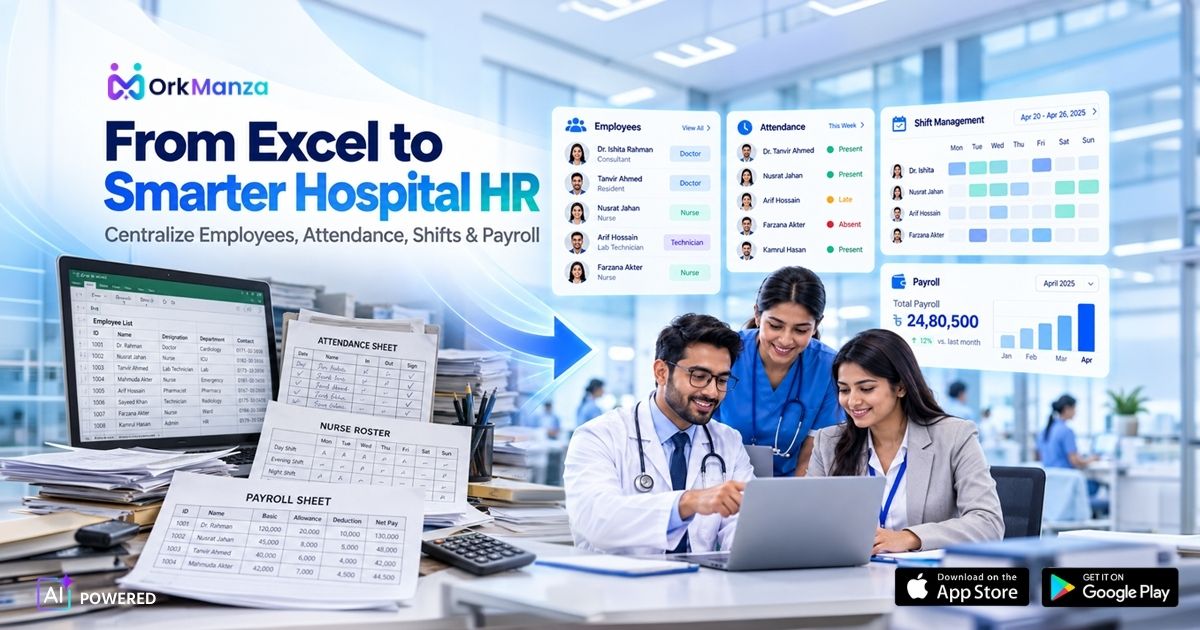
Why Hospitals Should Move from Excel to HR Software
Excel works when a facility is small and its processes are simple. As staff numbers, shifts, and pay components grow, spreadsheets become a source of risk. Here is how the two approaches compare.
| Area | Excel / Paper-Based HR | Hospital HR Software |
| Attendance | Manual registers or exported device files | Automatic capture linked to shifts |
| Rosters | Static sheets, hard to update | Dynamic rosters with conflict checks |
| Overtime | Calculated manually, often disputed | Calculated from scheduled vs actual hours with approvals |
| Payroll | Manual formulas are error-prone | Rule-based calculation from live data |
| Leave | Paper forms or messages | Online requests, balances and approvals |
| Employee records | Scattered files and folders | Centralized, searchable database |
| Reporting | Built each month manually | On-demand dashboards and exports |
| Audit trail | Weak, easy to overwrite | Change history and role-based access |
| Scalability | Becomes unmanageable as headcount grows | Handles more staff and branches |
| Employee experience | Staff depend on HR for every query | Self-service for rosters, leave, and payslips |
This does not mean Excel is useless. It means payroll and attendance for a 24/7 workforce are better handled in a system built for them.
Benefits of Using OrkManza AI-Powered HR Software in Hospitals
Reduced administrative workload: HR teams spend less time copying data between sheets and more time on people management.
Fewer payroll errors: When attendance, leave, and overtime flow directly into payroll, manual mistakes drop.
Safer shift planning: Visibility into coverage, leave, and hours worked helps managers build rosters more effectively.
Accurate attendance: Shift-aware attendance avoids false late marks and missed overtime.
Faster payroll processing: Payroll that once took several days of reconciliation can be prepared faster because the inputs are already verified.
Improved employee experience: Staff can see their roster, apply for leave, and download payslips themselves, reducing confusion and complaints.
Centralized employee records: Contracts, certificates, and documents are stored in one place, not across drawers and personal laptops.
Clearer HR reporting: Directors can review overtime cost, absenteeism, and headcount by department without waiting for manual reports.
Operational efficiency improves: Better rosters and attendance data support smoother ward operations.
Better compliance tracking: Complete, organized records make it easier to respond to internal reviews or external audits.
How to Choose the Best HR Software for a Hospital in Bangladesh
Use this checklist to evaluate vendors. Focus on fit, not the longest feature list.
- Hospital-specific shift management: Does it support rotating shifts, night shifts, on-call coverage, swaps, and minimum staffing rules?
- Payroll capabilities: Can it handle multiple allowances, overtime rules, deductions, advances, and bonuses for each employee group to keep payroll accurate?
- Attendance integration: Does it connect to your biometric or RFID devices and mobile attendance?
- Mobile accessibility: Can staff and managers use rosters, leave, and approvals on their phones?
- Reporting: Are there ready reports for attendance, overtime, payroll, and headcount, with export options to review data quickly?
- Security: Look for role-based access, audit logs, and encryption. Keep salary data sensitive and protected.
- Scalability: Will it handle more employees, departments, and branches as you grow without slowing operations?
- Customization: Can you adjust salary structures, leave policies, and approval flows to your own rules so the system fits your process?
- Local payroll requirements: Does the vendor understand Bangladesh's payroll practices, including festival bonuses, local tax deductions, and BDT-based processing?
- Customer support: Is support available in Bangla and English, and during your working hours
- Pricing: Is pricing clear, including setup, training, support, and add-ons
- Data backup: Ask how data is backed up, where it is stored, and how it can be exported if you change vendors, so you keep control of your data.
- Integration capabilities: Can it work with your accounting software, hospital management system, or attendance hardware to keep systems connected?
Ask for a demo using your real scenarios: a night-shift roster with a swap, an overtime approval, and a payroll run for two employee categories. Generic demos hide weaknesses and the real fit.
OrkManza as an Example of Modern HR and Payroll Software in Bangladesh
Among the HR and payroll platforms built for organizations in Bangladesh, OrkManza is one example hospitals can evaluate. It is a cloud-based HR and payroll solution designed around local business practices.
Features relevant to hospital HR teams include:
- Attendance Management with device and mobile options
- Shift & Roster Management for multi-shift operations
- Payroll Management with salary structures, allowances, deductions, and payslips
- Leave Management with approval workflows.
- Employee Database for centralized records
- Recruitment for ongoing hiring
- KPI & Performance Management for appraisals
- Employee Self-Service for rosters, leave, and payslips.
- Analytics for HR and payroll reporting
- Mobile App for staff and managers
- Geo Attendance for location-verified check-ins
- Expense Management for claims and reimbursements
As with any vendor, hospitals should test it against their own scenarios: rotating nurse rosters, visiting doctor arrangements, overtime approval, and payroll for different employee groups. A pilot with one department is a sensible way to evaluate fit before a full rollout.
Is OrkManza HR Software Suitable for Small Clinics and Diagnostic Centers?
Yes. OrkManza HR Software can apply the same HR technology principles to smaller healthcare organizations.
Small Clinics: A clinic may have fewer employees, yet it can still benefit from centralized attendance, leave, payroll, and employee records.
Diagnostic Centers: Diagnostic centers often have technicians, receptionists, administrative staff, and other employees working according to different schedules, making coordination more important.
Digital shift and attendance management can simplify these processes for smaller teams.
Dental Clinics: Dental clinics can use HR software to manage staff attendance, leave, payroll, employee records, and performance more efficiently.
Specialized Hospitals: Specialized hospitals may require department-specific shifts and employee categories, which HR software can help manage more effectively.
Large Hospitals: Large hospitals can benefit from centralized HR data, multi-department workforce management, analytics, and payroll automation for smoother operations.
Healthcare Groups: Organizations operating multiple hospitals or healthcare facilities may need centralized visibility while maintaining separate locations or departments to better control operations.
The appropriate solution depends on the organization's workforce size, operational complexity, budget, and HR requirements, so the best fit is the one that matches those needs.
Conclusion
Choosing the right HR software for hospitals in Bangladesh is less about technology and more about control: knowing who is on duty, who worked, what they are owed, and where the records are. Hospitals that move from scattered spreadsheets to a connected system usually gain accuracy, time, and confidence.
If you manage a hospital, clinic, or diagnostic center, a practical next step is to list your current HR pain points and review two or three solutions against them. A small pilot, such as a single department's roster and payroll, will quickly show whether a system fits your operation.
Frequently Asked Questions
HR software for hospitals in Bangladesh is a digital system that helps hospitals manage employee records, attendance, shifts, payroll, leave, overtime, recruitment, performance, and workforce reporting in one place.
Hospitals need HR software to manage 24/7 operations, multiple shifts, different employee categories, attendance, overtime, payroll, leave, and employee records more efficiently than manual or Excel-based processes.
Yes. Hospital HR software can manage day, night, and rotating shifts, employee rosters, nurse and doctor schedules, shift changes, overtime, late attendance, and staffing assignments.
OrkManza AI-Powered hospital HRMS can manage basic salary, allowances, overtime, deductions, bonuses, attendance-based adjustments, leave-related calculations, payslips, and payroll reports based on configured company policies.
HR software can be used by small clinics, diagnostic centers, dental clinics, specialized hospitals, and large healthcare organizations to manage employee records, attendance, leave, shifts, and payroll.
The cost of hospital HR software in Bangladesh depends on employee numbers, required modules, payroll complexity, customization, implementation, support, integrations, and whether the software is cloud-based or on-premise.
Try OrkManza for Free
Automate HR, attendance, payroll, tasks and more. Track all your key metrics in one powerful platform.