
Biometric vs. Mobile GPS Attendance: Which is Right for Your Business in Bangladesh?
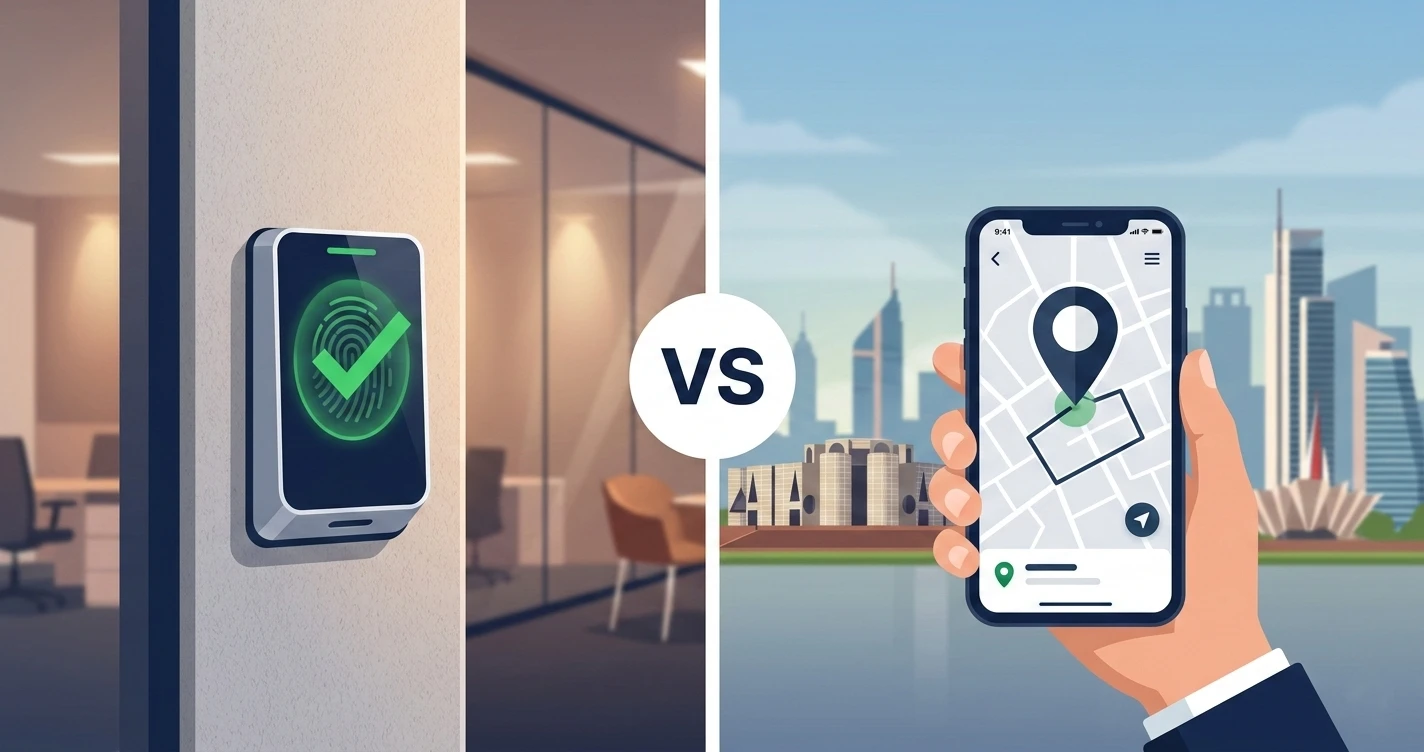
Managing employee attendance has always been one of the biggest operational headaches for businesses across Bangladesh. Whether you run a garments factory in Gazipur, a software house in Gulshan, or a chain of retail stores in Chittagong, keeping accurate, tamper-proof attendance records is non-negotiable. And in today's landscape, two technologies dominate the conversation: biometric attendance systems and mobile GPS-based employee attendance apps.
But which one is actually right for your business? The honest answer is: it depends. Both systems have genuine strengths and real limitations, and understanding those differences — in the context of Bangladesh's unique business environment — is exactly what this guide is about.
The State of Attendance Management in Bangladesh
For years, the biometric attendance system in Bangladesh has been the go-to solution for mid-to-large enterprises. Walk into almost any corporate office in Dhaka, and you'll likely spot a fingerprint or face recognition device mounted near the entrance. It became the standard — and for good reason.
But the rise of remote work, field teams, and mobile-first HR management has opened the door for GPS-based employee attendance apps. Suddenly, a factory supervisor in Narsingdi can mark attendance from a smartphone, and an HR manager in Dhaka can see real-time location data on a dashboard without installing a single hardware device on-site.
So the question isn't really "which technology is better?" It's "which one fits your workforce, your industry, and your budget right now?"
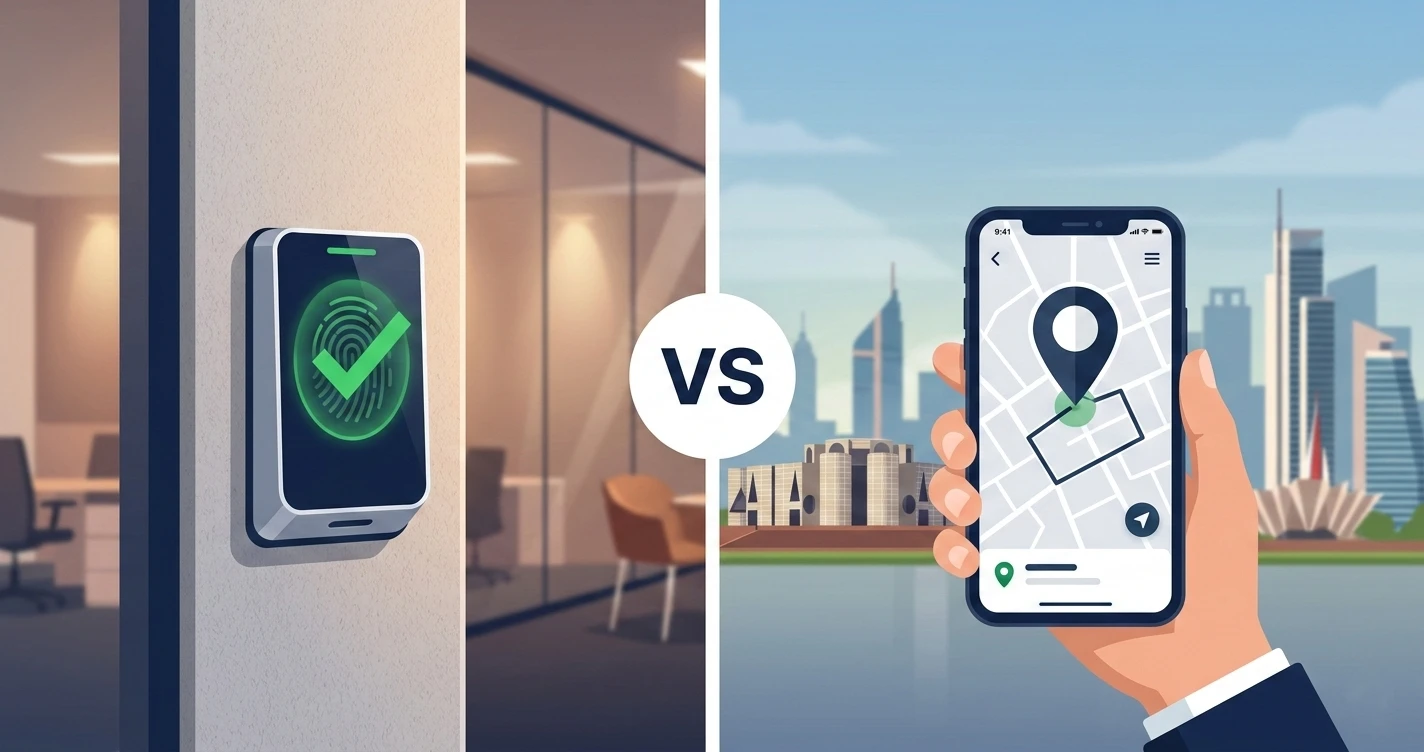
What is a Biometric Attendance System?
A biometric attendance system uses unique physical characteristics — most commonly fingerprints, but sometimes face recognition or iris scans — to verify and record employee attendance. The device is installed at a fixed location, typically at office entry/exit points, and employees simply scan in and out.
In Bangladesh, brands like ZKTeco, Hikvision, and Suprema are widely used. These devices integrate with HR attendance software that automatically generates reports, calculates overtime, and feeds data into payroll systems.
Key Advantages of Biometric Systems
- Eliminates buddy punching — no one can clock in for someone else
- Works without internet connectivity once set up
- Provides high accuracy and tamper-resistant data
- Widely trusted and accepted by compliance auditors
- One-time hardware investment with long device lifespan
- Works well for large numbers of employees clocking in quickly
Limitations to Consider
- Hardware cost can be significant for SMEs (typically BDT 8,000–35,000+ per device)
- Requires installation and maintenance of physical devices
- Useless for remote workers, field sales teams, or traveling employees
- Hygiene concerns — fingerprint scanners were a real friction point during and after COVID-19
- Integration with modern HR attendance software can be complex and costly
- If the device breaks down, attendance tracking stops entirely
What is a Mobile GPS Attendance App?
A mobile GPS employee attendance app allows workers to mark their attendance from a smartphone using their live location. The app uses GPS coordinates to verify that an employee is physically present at the right workplace or job site when they clock in or out.
Modern GPS-based HR attendance software goes beyond just tracking location. It often includes geo-fencing (setting virtual boundaries for valid check-in zones), selfie verification, shift scheduling, leave management, and real-time reporting — all accessible from any browser or mobile device.
Key Advantages of GPS Attendance Apps
- No hardware required — dramatically lower upfront cost
- Perfect for remote workers, field teams, and multi-location businesses
- Real-time visibility of where employees are checking in from
- Easy deployment — employees just download an app
- Integrates smoothly with cloud-based HR attendance software
- Supports work-from-home and hybrid workforce models
- Geo-fencing prevents check-ins from unauthorized locations
Limitations to Consider
- Requires employees to have a smartphone — not always guaranteed
- Dependent on internet connectivity and GPS signal quality
- Some employees may find GPS tracking intrusive (privacy concerns)
- Can be gamed if geo-fencing isn't properly configured
- Ongoing subscription costs for cloud-based software
- Less suitable for large groups needing rapid clock-ins at a single gate
Side-by-Side Comparison: Biometric vs. GPS Attendance
| Feature | Biometric System | Mobile GPS App |
|---|---|---|
| Setup Cost | High (hardware purchase) | Low (app subscription) |
| Best For | Office/factory workers | Remote/field employees |
| Internet Required? | No (post-setup) | Yes |
| Anti-buddy Punch? | Yes (biometric) | Yes (geo-fence + selfie) |
| Multi-location Support | Requires multiple devices | Unlimited locations |
| Work-from-Home Ready? | No | Yes |
| Employee Device Needed? | No | Yes (smartphone) |
| Payroll Integration? | Yes (via software) | Yes (via cloud HR software) |
| Maintenance | Hardware upkeep needed | Automatic software updates |
| Data Security | On-premise/local | Cloud-based (encrypted) |
| Ideal Business Size | Mid to large enterprises | SMEs to large enterprises |
Which Industries in Bangladesh Benefit Most from Each?
Biometric Attendance System Works Best For:
Garments & Manufacturing: RMG factories with hundreds of workers clocking in simultaneously need fast, reliable gate-entry systems. Biometric devices handle high volumes efficiently and are accepted by compliance auditors like BGMEA.
Banks & Financial Institutions: Security-sensitive environments where physical presence verification is critical. Most major banks in Bangladesh already use biometric systems as part of their broader security infrastructure.
Government & Semi-Government Organizations: Where accountability is paramount and digital verification needs to be unambiguous for audit purposes.
Educational Institutions: Schools and universities with fixed-location staff benefit from cost-effective biometric terminals that work without constant internet connectivity.
Mobile GPS Attendance App Works Best For:
IT & Software Companies: Tech firms with remote developers, hybrid work policies, and geographically distributed teams need flexible HR attendance software that employees can use from anywhere.
Real Estate & Construction: Project managers and site engineers working across multiple locations across Dhaka, Chattogram, or Sylhet can check in from their job sites without needing dedicated hardware.
Sales & Field Teams: Pharmaceutical companies, FMCG distributors, and telecom companies with large field forces need real-time GPS check-ins to verify that sales reps are actually visiting their assigned territories.
Logistics & Delivery: Courier companies and last-mile delivery services can track driver attendance and movements in real time through a mobile employee attendance app.
NGOs & Development Organizations: Field workers spread across rural Bangladesh can use GPS apps to check in without requiring fixed hardware in remote locations.
The Case for Using Both Systems Together
Here's a practical reality that many Bangladeshi businesses are discovering: you don't always have to choose one or the other. A hybrid approach is increasingly common — and often the smartest option.
Consider a mid-sized pharmaceutical company in Dhaka. Their head office and warehouse staff clock in through biometric terminals. Meanwhile, their field medical representatives use an employee attendance app with GPS tracking to check in from doctor's offices and hospital visits across the country. All data feeds into the same HR attendance software, giving the HR team a unified view of workforce attendance regardless of where employees are working.
This hybrid model gives you the security and reliability of biometrics where it makes sense, and the flexibility of GPS-based tracking where physical hardware isn't practical.
What to Look for in HR Attendance Software
Regardless of which hardware approach you choose, the HR attendance software sitting behind it matters enormously. Here's what Bangladeshi businesses should prioritize when evaluating attendance management platforms:
- Bangladesh-specific payroll compliance: The software should understand local leave policies, overtime rules, and festival holiday calculations under the Bangladesh Labor Law
- Integration capabilities: Can it connect with your existing payroll system, ERP, or HRM platform?
- Real-time dashboard: HR managers should be able to see attendance data live without manual report generation
- Mobile access: A responsive mobile interface for managers and employees is essential
- Multi-shift support: Critical for factories and hospitals operating round-the-clock
- Custom reports: Ability to generate department-wise, project-wise, or location-wise attendance reports
- Data security: For cloud-based solutions, ensure proper encryption and access controls
- Local support: Access to Bangladeshi customer support and technical assistance is a significant practical advantage
Cost Considerations for Bangladeshi Businesses
Cost is always a major factor in technology decisions, and this comparison is no different. Let's break it down practically.
Biometric System Costs
- Entry-level fingerprint device: BDT 8,000–15,000 per unit
- Mid-range face recognition device: BDT 20,000–50,000 per unit
- Installation and cabling: BDT 3,000–8,000 per device
- Software license (HR attendance software): One-time or annual fee
- Maintenance and replacement parts: Ongoing
GPS Attendance App Costs
- Most cloud-based solutions charge per employee per month: BDT 100–400 per employee
- No hardware cost
- No installation cost
- Automatic updates included in subscription
- Scales easily as you hire more staff
For a company with 50 employees, a basic biometric setup might cost BDT 50,000–100,000 upfront, while a GPS app might run BDT 6,000–20,000 per month, depending on the platform. For smaller teams or businesses with field staff, the GPS app often wins on total cost of ownership. For larger factories where you need to process hundreds of workers through a gate quickly, biometric devices usually make more economic sense.
Privacy and Legal Considerations in Bangladesh
One aspect that doesn't get discussed enough is the privacy dimension of attendance tracking. Both biometric systems and GPS apps involve collecting sensitive employee data — and businesses in Bangladesh need to think carefully about this.
Biometric data (fingerprints, facial geometry) is among the most sensitive personal data that exists. It cannot be changed if compromised. While Bangladesh doesn't yet have comprehensive data protection legislation on the level of Europe's GDPR, the Digital Security Act and emerging personal data protection discussions mean that businesses should handle biometric data responsibly — securing storage, limiting access, and being transparent with employees.
GPS tracking also raises legitimate employee privacy concerns. Workers may feel uncomfortable being constantly tracked. Best practice is to be transparent about what data is collected, when tracking is active (only during work hours), and how data is used. Many employee attendance apps now allow employees to disable location tracking outside of check-in/check-out events, which helps address these concerns.
Regardless of which system you use, maintaining employee trust through clear communication is not just ethical — it's practical. Employees who understand and accept the system are less likely to find ways around it.
How to Make the Right Decision for Your Business
Still not sure which direction to go? Ask yourself these questions:
- Do most of my employees work at a fixed physical location every day?
- Do I have remote workers, field teams, or staff at multiple sites?
- What is my budget for upfront hardware vs. ongoing monthly costs?
- How important is internet-independent operation to my business?
- Do my employees have smartphones, and are they comfortable using apps?
- What compliance or audit requirements do I need to satisfy?
- Am I planning to grow my team significantly over the next 1–2 years?
If most of your workers are in one place and reliability without internet is critical, go biometric. If your team is distributed, remote, or field-based — go GPS. If you have both types of workers, consider a hybrid approach supported by integrated HR attendance software that handles both.
Final Verdict
There's no universally superior option between a biometric attendance system and a mobile GPS employee attendance app — only the right fit for your specific business context. In Bangladesh's diverse business landscape, both technologies serve real and important needs.
What matters most is that your chosen solution integrates properly with your HR attendance software, complies with local labor regulations, gives your HR team real-time visibility, and is accepted and used correctly by your employees.
The worst attendance system is the one that looks good on paper but gets bypassed in practice. The best one is the system your team actually uses — consistently, accurately, and without friction.
Take the time to assess your workforce structure, your operational requirements, and your budget. Talk to vendors who understand the Bangladeshi business context. And if you're still uncertain, start with a pilot: roll out the system for one department or location, measure the results, and scale from there.
Your employees' time is your business's most valuable resource. The right attendance system helps you manage it wisely.
Try Orkmanza for Free
Automate HR, attendance, payroll, tasks and more. Track all your key metrics in one powerful platform.